
Frameworks For Writing Clear Learning Objectives—Infographic
A good learning objective does more than list what a course includes. It tells learners what they can expect and gives trainers a way to measure progress. Using the right framework helps turn a general goal into a clear, specific result that learners can show.
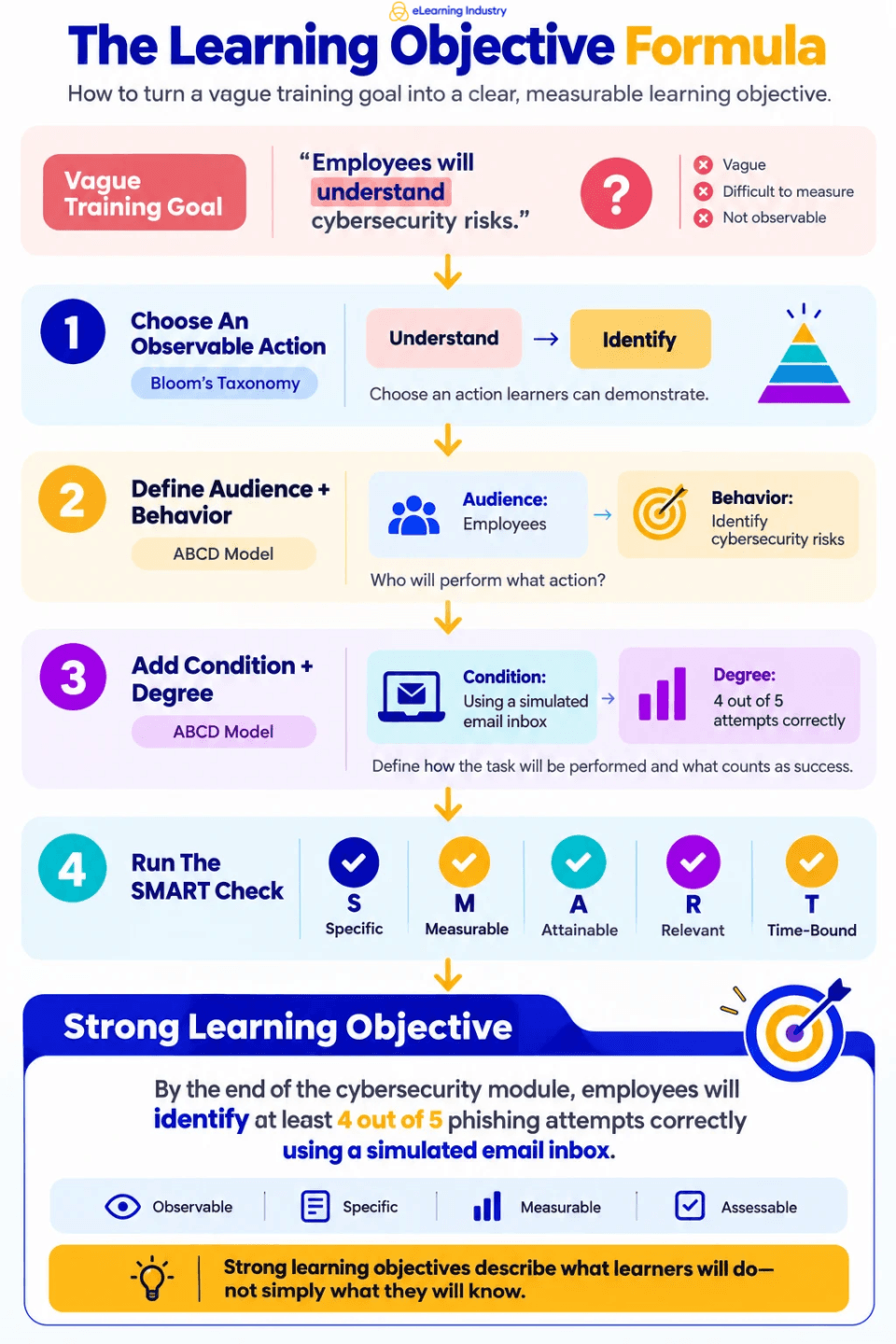
Bloom's Taxonomy (Remembering To Creating)
Bloom's Taxonomy helps you decide how deeply learners need to think about a topic. Its levels go from simple recall to more complex thinking skills.
At the lower levels, learners remember and understand facts, terms, and concepts, then use them to finish a task or solve a familiar problem.
At the higher levels, learners analyze and break down information, judge evidence or standards, and combine ideas and skills to create something new.
This framework helps you pick objectives that match the needed level of learning. For example, asking someone to spot data security risks is simpler than asking them to judge a security breach and make a response plan.
The SMART Criteria (Specific, Measurable, Attainable, Relevant, Time-Bound)
The SMART criteria (Specific, Measurable, Attainable, Relevant, and Time-Bound) help turn an idea into a clear and focused goal for learning and assessment.
- Specific: State in clear, simple language what the learner should achieve.
- Measurable: Pick a way to track, assess, or see progress.
- Attainable: Ensure the goal is realistic given the learner's current skills, resources, and available training time.
- Relevant: Connect the objective to the learner's job, growth needs, or the main purpose of the training.
- Time-Bound: Give a clear deadline or time frame for reaching the goal.
The ABCD Model (Audience, Behavior, Condition, Degree)
The ABCD model splits an objective into four key parts: audience, behavior, condition, and degree.
- Audience: Identifies who is expected to perform the task (e.g., new sales trainee or customer support representative)
- Behavior: States the specific action the learner should perform (e.g., operate the software or complete a thesis statement)
- Condition: Explains the circumstances under which the learner will perform (e.g., using a CRM tool or without AI tools)
- Degree: Defines the criteria for success (e.g., with 70% accuracy or within 10 minutes)
Using these frameworks can turn unclear training goals into clear objectives. They show learners what to achieve, how to do it, and what success looks like.


You can adjust your cookie preferences here.