
The AI Adoption Maturity Level—Infographic
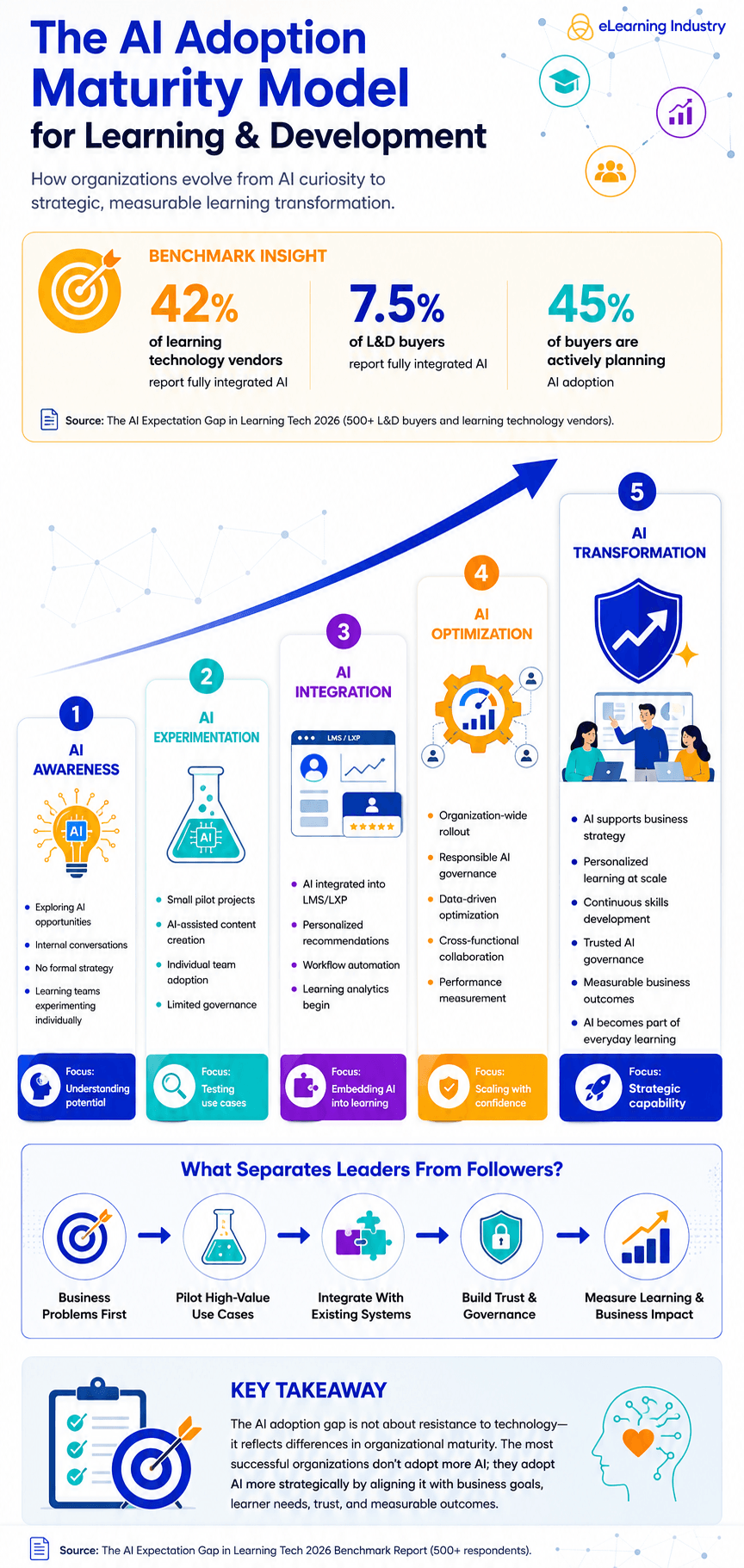
The AI Adoption Maturity Model for Learning and Development illustrates an important reality highlighted by The AI Expectation Gap in Learning Tech 2026: AI adoption is not a single implementation milestone. Instead, organizations progress from experimentation toward strategic integration as their capabilities, governance, and ability to measure impact mature.
The report reveals a striking gap between technology supply and organizational readiness. While 42% of learning technology vendors report fully integrated AI, only 7.5% of L&D buyers say AI is fully integrated into their learning environments. Yet adoption is accelerating: 45% of buyers are actively planning AI adoption. Together, these findings suggest that many organizations are currently moving between the awareness, experimentation, and integration stages of AI maturity.
Early-stage organizations may begin with individual experimentation, AI-assisted content creation, or limited pilots. However, maturity requires moving beyond isolated use cases. At the AI Integration stage, AI becomes embedded in LMSs, LXPs, recommendations, workflows, and learning analytics. More advanced organizations then focus on optimization through governance, performance measurement, cross-functional collaboration, and data-driven decision making.
The final stage—AI Transformation—is not defined by having the largest number of AI tools. Instead, AI becomes a strategic capability that supports personalized learning at scale, continuous skills development, and measurable business outcomes.
This distinction is particularly important given another finding from the report: 65% of L&D buyers identify personalized learning experiences as the AI capability they value most. Buyers are therefore signaling that AI's value lies in improving learning outcomes and experiences, not simply increasing automation.
The maturity model also helps explain why organizations should resist pursuing AI adoption for its own sake. Progress depends on selecting high-value business problems, integrating AI with existing technology, establishing responsible governance, and measuring results.
Ultimately, AI maturity in L&D is about strategic capability, not technological novelty. Organizations that connect AI investment with learner needs, business priorities, trust, and measurable outcomes will be better positioned to turn experimentation into sustainable learning transformation.


You can adjust your cookie preferences here.