


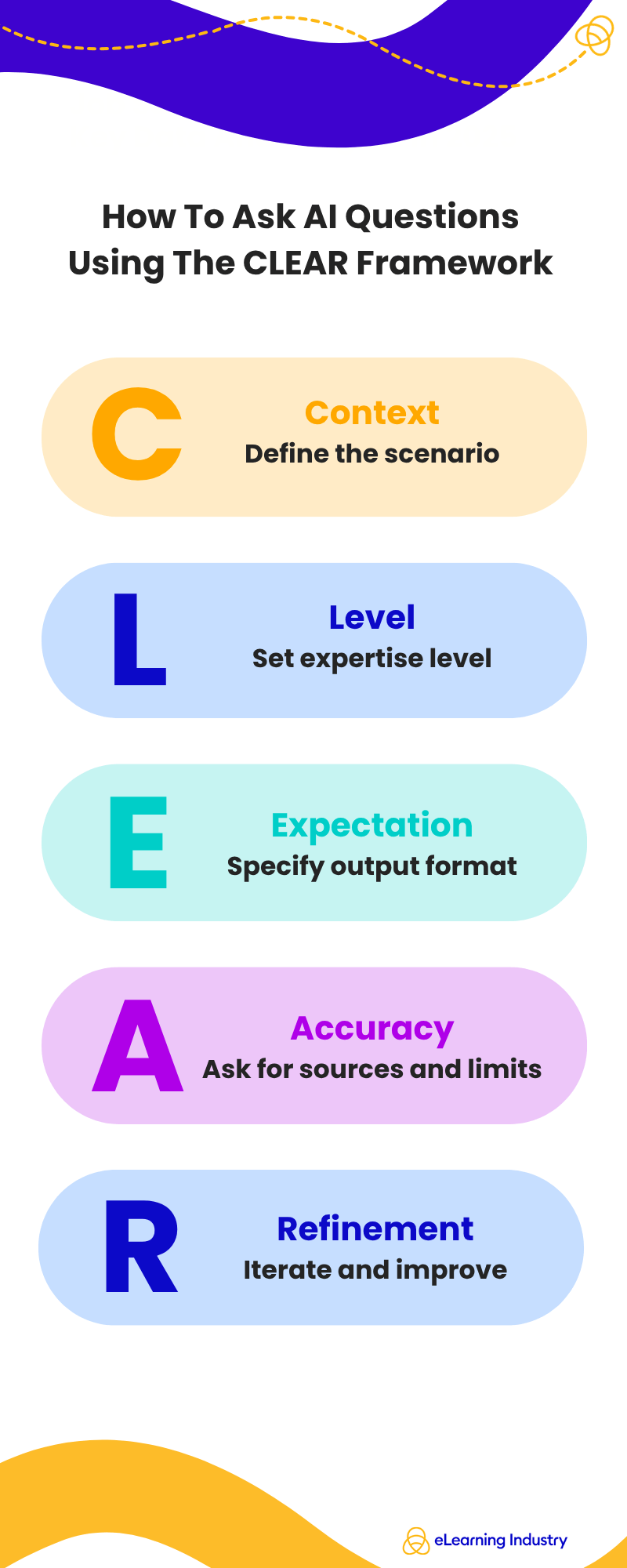
How To Ask AI Questions Effectively—Infographic
To ask AI questions effectively, focus on how you structure your prompts. The difference between average and high-value AI questions and answers often comes down to structure. If you have ever wondered, "How do I ask AI a question in a way that delivers usable results?", a simple framework can make that process easier.
One such framework is the CLEAR framework. It is designed to help professionals get consistent, high-quality outputs when working with any AI to answer questions. Let's break it down.
C—Context: Define The Scenario
AI performs best when it understands the situation. Instead of asking broad or generic AI questions, provide background.
- What is the business goal?
- Who is the audience?
- What constraints exist?
Example:
Instead of: "Create training content."
Ask: "Create onboarding training for remote sales teams in a SaaS company with a focus on product adoption."
Adding context improves how AI answers questions by narrowing the scope and aligning the response with real-world needs.
L—Level: Specify Expertise Level
One of the most overlooked aspects of how to ask an AI assistant questions is defining the level of complexity.
- Beginner (new hires, basic understanding)
- Intermediate (working professionals)
- Advanced (leaders, specialists)
Example:
"Explain this as if I am a senior L&D leader designing an enterprise learning strategy."
This ensures the output matches the required knowledge level, making AI questions and answers more actionable.
E—Expectation: Define Output Format
AI can deliver information in multiple formats. If you do not specify, you risk receiving unstructured responses.
- List
- Framework
- Table
- Step-by-step guide
Example:
"Provide a 5-step framework in bullet points."
This step is critical in how to ask AI a question, especially when outputs are used in reports, learning materials, or stakeholder presentations.
A—Accuracy: Ask For Sources, Constraints, Or Assumptions
AI does not always clarify its reasoning. To improve reliability when using AI to answer questions, explicitly request validation.
- Ask for assumptions.
- Request limitations.
- Include source-based reasoning when needed.
Example:
"Include assumptions and note any limitations in your answer."
This approach strengthens trust in AI answers, particularly for strategic decisions in L&D.
R—Refinement: Iterate With Follow-Up Prompts
The first response is rarely the final one. Strong users of AI treat it as a conversation.
- Clarify unclear points.
- Ask for expansion or simplification.
- Request alternative perspectives.
Example:
"Refine this for a global audience" or "Make this more concise."
Refinement is what distinguishes basic usage from advanced question-answering AI practices.


You can adjust your cookie preferences here.